
Mommy Dearest
Are mom's ok? A pair of new films, Die My Love and If I Had Legs I'd Kick You, signal a moment for motherhood.

“Mommy is stretchable.”—Linda (Rose Byrne) in If I Had Legs I’d Kick You
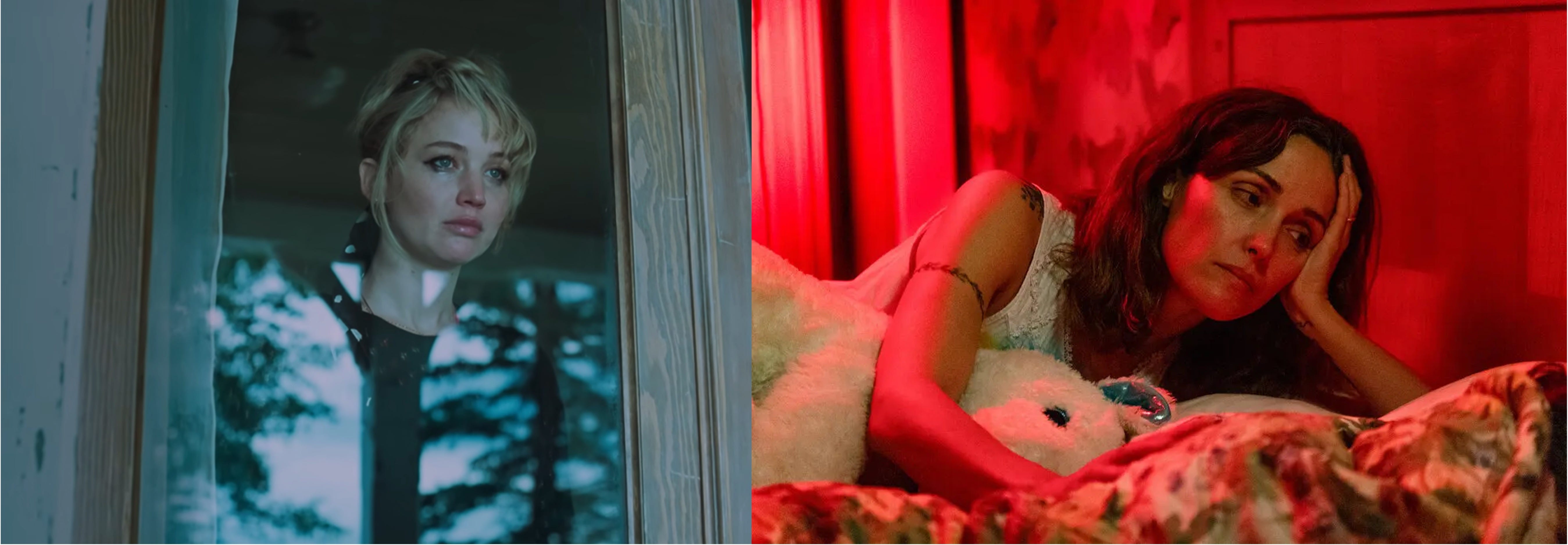
“Mother” carries a variety of meaning these days. Mother is Gaga, Rhianna, Taylor (I guess), Beyoncé, and the mother of them all is Madonna. Mother is mutha. Mother is planet Earth. Mother is Maya Rudolph. “Mother” by John Lennon played over the opening credits of Pamela Adlon’s Better Things, an excellent show about a… mother. Mother is Lynne Ramsay’s Die My Love and Mary Bronstein’s If I Had Legs I’d Kick You, two films about… “mother.” These magic carpet ride of films totally, completely, and unapologetically investigate and eviscerate the experience of being a mom. It’s a tough job, but somebody has to do it!
The mother’s played by Jennifer Lawrence and Rose Byrne in their respective films articulate a recent and resounding refute of mommyhood on screen. Their performances almost feel like watching an abstract expressionist stand still with a cigarette dangling from their mouth while they stare at a blank canvas and then suddenly with a sharp and violent flick of their paintbrush, convey a very necessary feeling. Gone are happy, cheery housewives or women who can have it all with career (check!), hunky husband (check!), and doting adorable baby (check!). I keep going back to that poster of Baby Boom with Diane Keaton in a sensible skirt suit and heels with her child on one hip and briefcase in the other hand. It’s an admirable fantasy, but not a realistic one. Die My Love and If I Had Legs I’d Kick You create immersive, darkly complicated worlds for their main mommy’s to struggle and triumph within. Without offering easily understood answers or sympathetic readings of their hero’s, I thought both films confidently stuck to their guns to show and tell that motherhood is a lot of things (it’s not pretty and that’s ok!) — it’s cringe, it’s frustrating, it’s exhausting, it’s overwhelming, it can inspire rage, madness, or horniness. Simply, how do moms do it all and should they be able to do it all when the expectations of being “a good mom” are as arbitrary as they are crushing. Both films excavate this notion, and then some, with varying results.
Full disclosure, I’m not a mom nor do I have children. However, I do watch a lot of movies where female characters are often mothers, mother-like figures, or the act of procreating is central to our understanding of women’s role in society. The mom archetypes in movies run the gamut of the nurturing and loving mom (Sally Field in Steele Magnolias), the struggling single mom (Diahann Carroll in Claudine), the mother as a sexpot (Anne Bancroft in The Graduate), the wounded and wicked mom (Mo’Nique in Precious), the grieving mom (Naomi Watts in 21 Grams), the chilly mom that everyone is desperate for her approval (Michelle Yeoh in Crazy Rich Asians), the mom as rival (Shirley MacLaine in Terms of Endearment), the cool mom (Amy Poehler in Mean Girls), the self-sacrificial hardworking mom (Joan Crawford in Mildred Pierce), and the strong, but silent mom (Viola Davis in Doubt). Piece all of these women together and I’m sure if you ask any mom, they’re a bit of these women on any given day, or given minute. We ask a lot of women to embrace their role as mothers just as much as an actress would relish in an Academy Award winning role. Creating a child isn’t easy, nor is giving birth and and yet there is a cultural expectation that the role of mother is to be whole hardheartedly enjoyed and pleasurable. However, imagine all of the emotional labor, and physical labor, of raising and rearing children, juggling a career, being available to a husband or partner, or being both mother and father as a single parent, managing mental health and physical appearance during and after birth, being constantly worried about your child’s safety (and your own!), and unsure if you’re ever really do it “the right way.” It’s a raw deal that offers the promise of total personal fulfillment and an enhanced sense of identity. You are your kids! But what happens after you’ve given birth and you realize that none of it has the same meaning before birth and maybe you’re not the right mom for your child or partner? Not everyone can be a maternal, sane force, and look like a knock out in heels like Julia Roberts in Erin Brockovich. Die My Love and If I Had Legs I’d Kick You show a different slice of life where being a mom is a test more than it is a reward.
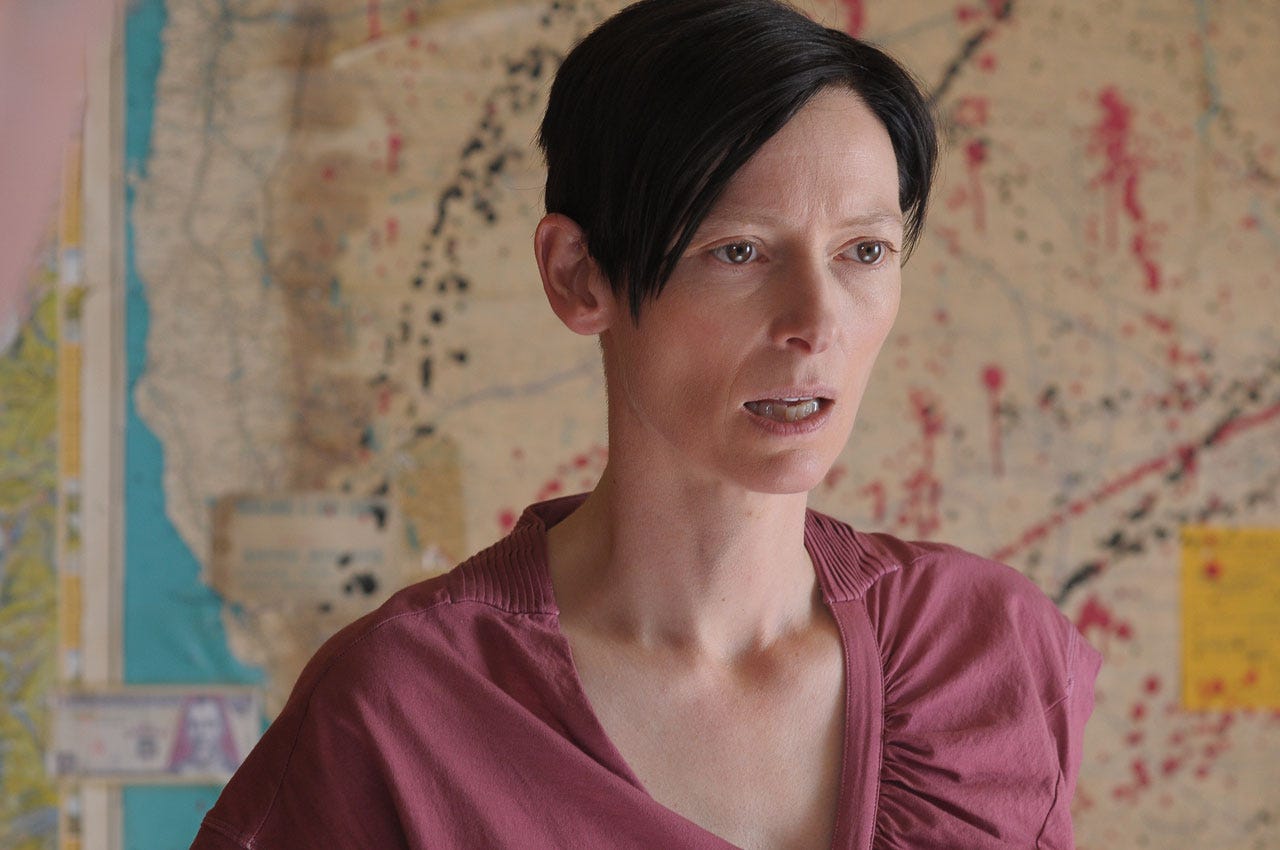
I recently revisited We Need to Talk About Kevin, another cautionary tale of parenthood by Scottish writer and director Ramsay, after I watched her latest film Die My Love. Though they were made fourteen years apart, a dialogue clearly exists between both films. In We Need..., Tilda Swinton stars as a mother traumatized not only by her initial inability to connect with her first child (a son) on an emotional level, but we also find her reeling from the fact that her son grows up to become a killer. Swinton’s character, Eva, is a successful travel writer who puts her career on hold to lean into being a mother. She and her dopey husband played by John C. Reilly leave their spacious Tribeca loft and move to the suburbs in a comically large and empty house (literally and metaphorically). Almost from the beginning Eva can feel this isn’t what’s meant for her and post-violence she’s reminded almost daily of her failings of being a “bad mom.” Spoiler alert, Eva still loves her son in spite of what he’s done. It’s the ultimate test a mom has to endure, how do you wrestle with your own part in creating a monster, and can you still feel a motherly bond to your child in spite of it all? Twinton delivers a fabulously still performance, and yet you can tell all of her vexed emotions are bubbling just beneath the surface.
In Die My Love, Lawrence stars as Grace (a name synonymous with what mother’s are expected to be and show), a writer and new mom who leaves her city life for a comically large and empty house (literally and metaphorically) in the country with her dopey husband played by Robert Pattinson. Sound familiar?

If all of Swinton’s trauma, horror, and peril of being a mom is internalized, likely due to the shock of her circumstance, then Lawrence’s mother in Die My Love is all externalized as she prowls like a feral cat in the woods, screams and shouts, and nearly explodes in every scene. One of my favorite forms of Movie Star Acting is acting with every inch of the body. Lawrence’s uses every pore and morsel of her being from her bangs to her eyeballs, to her bare feet, to her fingernails to claw her way through what we can safely assume is the rocket ship of postpartum mania. Grace is a changed woman as a mom, or is she? In a flashback to her wedding, Grace dances too hard, drinks too much, her dress doesn’t seem to fit. It’s almost child-like how she moves through the world, without much care for being respectable or proper. She’s definitely always been That Girl. Marriage, a move to a pastoral setting, and a new baby can have an impact on a gal and in Grace’s case, it’s dried her out in more ways than one. She’s unable to write, find pleasure in her house, or care for her child in the classic trad wife manor. Where she comes alive, she finds connection in nature be it an unspoken understanding with a stray horse, or a swimming pool where she can find solace after being stuck inside a banal neighborhood BBQ, and her final act in the film has her wondering deep into a fiery forest. Grace also finds a spiritual accomplice in her mother-in-law played spookily by Sissy Spacek, a wise casting choice as Spacek is a woman who famously knows how to become undone in a movie. It’s a go for broke performance that someone of Lawrence’s stature doesn’t have to give. As an Oscar winning actress under 40, surely she has the pick of the litter and could rest on her laurels as the Cool America’s Sweetheart. Lawrence seems compelled to often take risks with auteur filmmakers, be naked and unafraid in an unexpected role (literally and metaphorically), and she can still charm us when she appears on late night talk shows to promote ambiguously opaque movies about grief, the patriarchy, capitalism, sex, or other more mature subjects that require open hearts and open minds.
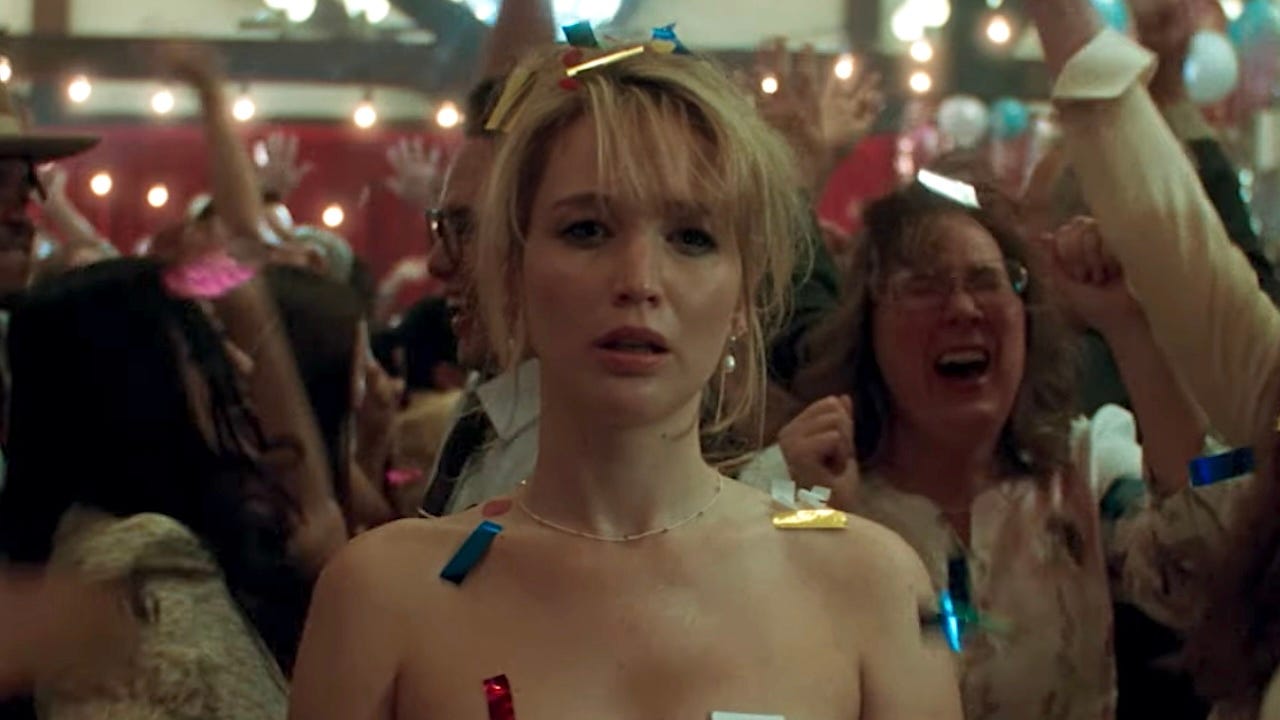
There’s not much story in Die My Love, it’s more concerned with character, texture, and ideas about the bounds of womanhood, or personhood really. For a film where Lawrence has been criticized for being over the top and annoying to watch, Ramsay’s last feature, You Were Never Really Here starring Joaquin Phoenix, about a hired, traumatized vigilante opened to rave reviews and won best screenplay at its Cannes debut. I only watched this movie fairly recently and found it insufferable because it’s in the canon of sad white guy movies where some dude must punish himself or someone else to restore order in society. Is there a double standard for movies about men who are cracking up versus women? I will say, I think some of the criticism of Die My Love being “grating” or “repetitive” is too simple or as critic Kong Rithdee surmised on the Film Comment podcast, as a man he simply couldn’t understand Grace’s postpartum spiral as it’s something he’ll never experience. What boneheaded reviews! If anything, this movie is very much consistent with Ramsay’s ability to explore the psychosis of traumatized people (her films range from a woman recovering from the suicide of her husband to the depths of poverty from a child’s perspective), and she has a keen eye to visually critique class. Someone has to show us pain as an audience to better understand our own, whether we’re the one’s giving birth or not. Die My Love might not be for everyone, but that’s not its aim. Lawrence is tortured for two hours and we’re left feeling haunted and unsure if she’ll ever find her true escape, but maybe that’s the point. Do any of us ever easily find our escape?
One last note on Die My Love, the immersive quality of the film is not only the result of the performances, but the strong cinematography by Seamus McGarvey (I haven’t seen a film shot day for night look this good in a long time!), the needle drops of just the right songs (David Bowie, John Prine and Elvis Presley to name a few), and the sound design of silence in the middle of the night or the piercing revving of a motorcycle engine.
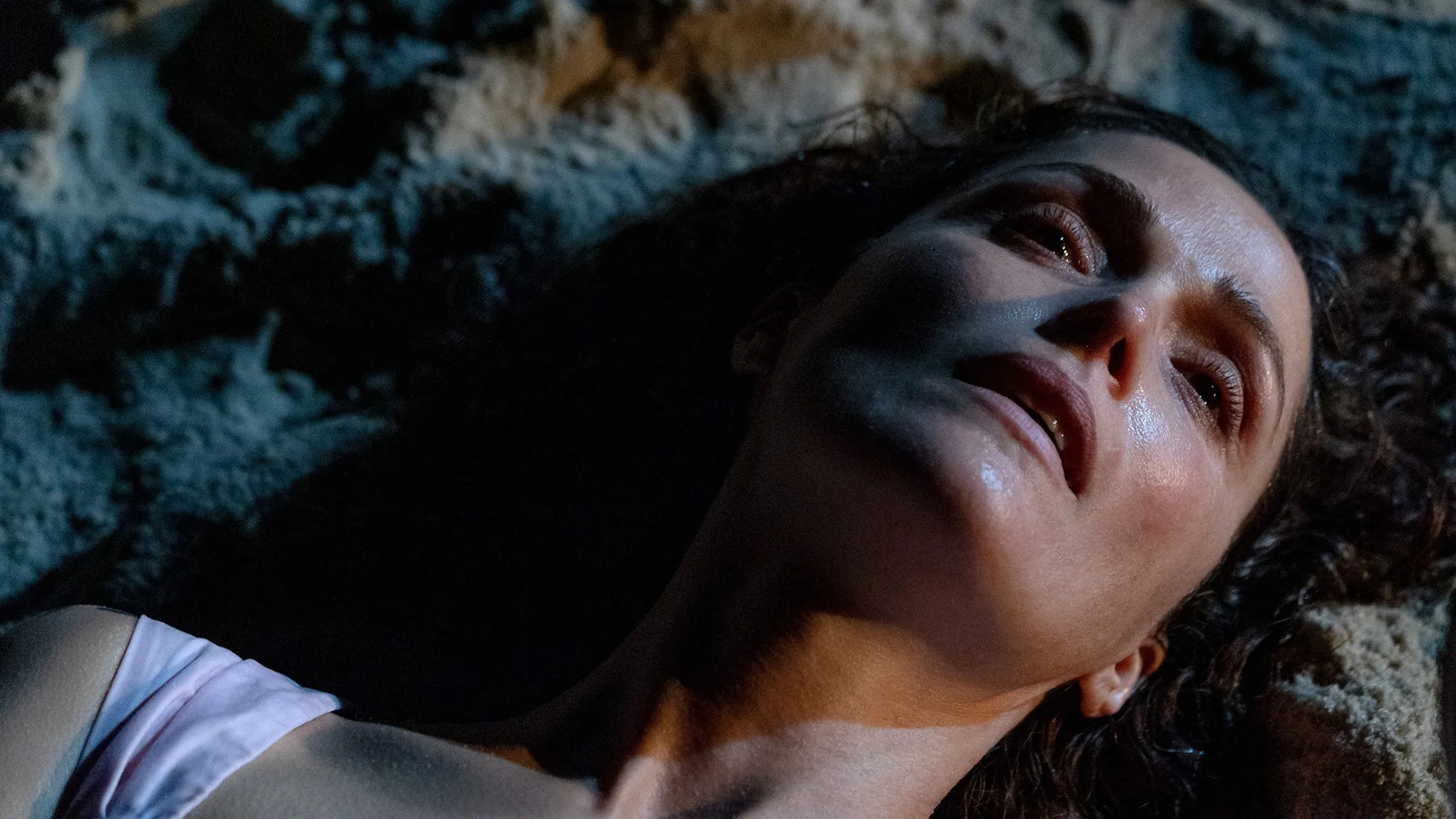
In If I Had Legs I’d Kick You, Byrne plays a woman who as she admits in the opening scene, she’s stretched as mommy. She’s tethered to her needy child, her mostly absent husband, her patients she’s helping as a therapist, and course her own therapist brilliantly played by Conan O’Brien. From the beginning she’s a woman under the influence of strain and worry as she’s trying to care for her ailing child. It’s another external performance that requires Byrne in one scene to aggressively shove a slice of disgusting pizza into her mouth and in another she has to body slam herself against ocean waves. The movie takes a formal swing in that until the very end of the film, we never see a clear close up of her sickly child. Her daughter is always purposely out of frame, although we hear her exasperating commentary and squeals off camera. The focus is on the headspace of Byrne’s Linda. It reminds me of how the adults in the Peanuts animated series are always out of the frame and when they speak, they’re heard in gibberish. It’s an inspired choice by writer-director Bronstein that locks you in to Linda’s story.
Linda and child have to temporarily move into a derelict hotel in Montauk run by Gen-Z nightmares who give Linda a hard time while she’s trying to cope with pot and what often looks like lukewarm nondescript white wine. The reason for the move is a gaping hole that has formed in the ceiling of Linda’s house, where early in the story the ceiling randomly collapses. As she returns to check on the progress of the repair the hole seems to grow larger and gnarlier. What might seem like an innocent home improvement transforms into a striking visual metaphor for all of Linda’s issues, her worry that she might not be able to save her child, the void she feels as a wife and adult, and a vortex of unspeakable feelings that similar to Grace in Die My Love maybe suggest she isn’t cut out to be a mom, much less a “good mom.”
Is this all happening in Linda’s head, or Grace’s for that matter? Do we believe women? The upside down, inside out reality in both films questions our accepted notions of how much sympathy and empathy we can have with women, or people who are generally having a bad day.
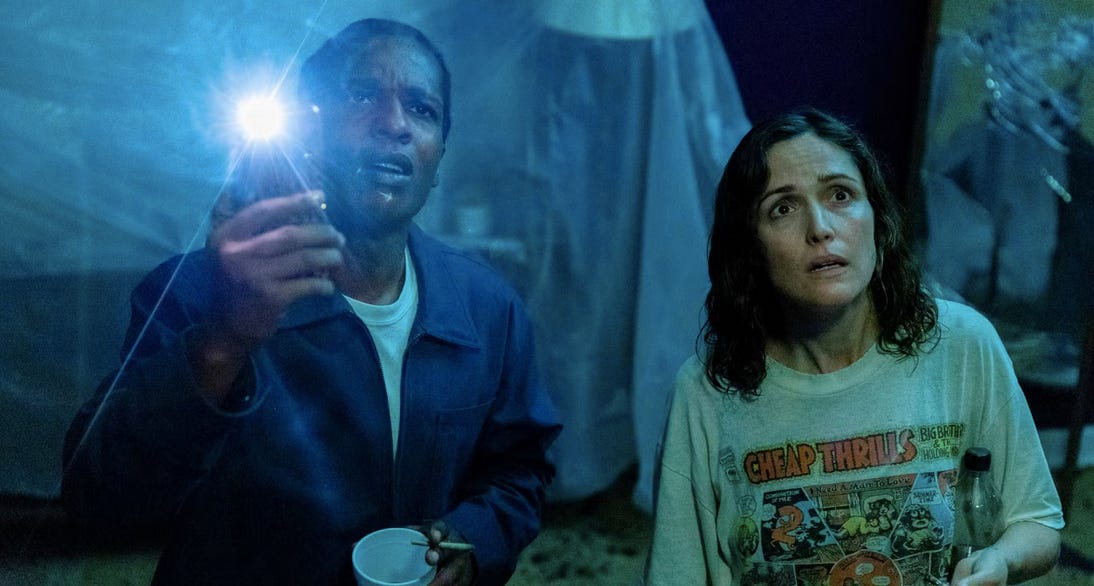
If I have a main criticism of both films is that the mothers in each are white, upper-middle class (Linda lives in Montauk) who find themselves drawn to and attracted to Black men as an answer to or escape from their own woes. In Die My Love it’s Lakeith Stanfield as the mysterious figure Karl who literally circles Grace from afar in a full leather kit on a motorcycle. Is he her ticket out of her own misbegotten love shack? He’s the opposite of her husband, he’s talk, dark, handsome and he can seemingly match her freak with a real or imagined roll in the hay. I don’t mind using character tropes to articulate a more nuance meaning if it’s grounded in something interesting, but Stanfield’s character could have been anyone. A$AP Rocky appears in If I Had Legs I’d Kick You as James, a calming presence for the mania that Linda is experiencing. He’s the nice guy who wants to order drugs, play video games, and hang out, perhaps all the things Linda wants in her own husband. This isn’t to diminish the superb talents of Stanfield or Rocky, but it’s a material choice I couldn’t help overlook that connects both films. See this dynamic explored more skillfully with Julianne Moore and Dennis Haysbert in Todd Haynes’ classic Far From Heaven.
And finally, where are these women on the verge of a nervous breakdown movies featuring women of color? Die My Love and If I Had Legs I’d Kick You are vehicles directed by critically acclaimed white female directors and both films premiered at prestige global film festivals (Sundance, Berlin, Cannes, Toronto, and New York film festivals NBD!) Imagine Ruth Negga or Danielle Deadwyler or Lily Gladstone receiving a similar path in a starry vehicle where they can rip their way through tales of what motherhood looks like for them. Surely being unhinged in the face of suppressing domesticity feels different for non-white women, and that’s a movie I’d like to see.
Lawrence and Byrne give two of the best and most memorable performances this year. Did their films answer the question, are mom’s ok? Maybe we should be asking that question to governments and social safety programs that could potentially make the lives of mothers just a little bit easier. The outward howls of mommyhood by Lawrence and Bryne reminded me of what the always reliable and always brilliant Amy Adams did in Nightbitch, another wild tale of a former creative woman turned suburban house wife who… grows a tail. I also couldn’t help but think of the inner work Teyana Taylor did in One Battle After Another, as a radical activist turned mom who in her own throws of postpartum depression decides to leave it all behind. It’s 2025, can’t women, or anyone really, want more out of life than what’s expected of them? Being a mom is a deeply personal journey. Seeing all versions of a being a Mother in movies, the joy and the pain, can help us understand the task at hand on their terms. In the famous last words of mother Perfidia Beverly Hills (Taylor) in One Battle After Another, this pussy don’t pop for you!