
Marcel Duchamp Times Two
Marcel Duchamp is the subject of a retrospective at MoMA and an intimate exhibit at the new Gagosian Madison Ave. What's all the fuss about?

When I walk into a large museum exhibit I tend to wear AirPods—not just to avoid anyone approaching me, but to drown out the noise and focus my attention. Depending on the artistic medium being presented, I might listen to music to accompany the experience. Major museums can be unbelievably crowded, especially mid-afternoon or on a weekend, but I still want them to feel like a calming space to expand my mind.
Recently I went to the Museum of Modern Art to see the career and life-spanning retrospective for Marcel Duchamp, his first retrospective in the United States since 1973. If I’m honest, I’ve been more familiar with his impact than his specific history—I was game to learn more.
As I entered the exhibit, I sifted through options on Spotify and landed on “Love Theme from Spartacus” by Yusef Lateef. I didn’t make it five feet into the show before I noticed the Norwegian model and artist Iselin Steiro, looking elegant in a simple sweater and jeans. Her husband is Anders Danielsen Lie, who appeared in a small role in Sentimental Value, a film that uses the same song in a brief montage.
What a way to start this exhibit, I thought. Steiro and I moved at nearly the same pace throughout each gallery.
Located on the 6th floor—where I’ve previously seen shows for Jack Whitten, Ruth Asawa, and Ed Ruscha—the exhibit framed Duchamp’s work and personal history chronologically, which was ideal for a novice like myself.
Born in northwestern France, Marcel Duchamp was one of seven children, four of whom were artists in their own right. As a teenager, he began sketching and painting, often in reaction to the styles of Paul Cézanne and Henri Matisse. The sketches caught my eye the most—the exaggerated female forms, many intended to be lightly provocative and submitted to humor magazines of the time. It’s here that I started to see a connection between that sense of levity, unconventional taste, and a somewhat perverse view of gender that would become a defining aspect of his larger body of work.
The series of female nudes in a Fauvist style—Nude with Black Stockings, The Bush, and Baptême—depict women in paintings as bulbous, relaxed, almost diaphanous creatures. Those figures are then rendered nearly invisible in motion in Nude Descending a Staircase, No. 2, his breakthrough work that resisted being defined as purely Cubist or Futurist.
First presented at the 1912 Salon des Indépendants in Paris, and later shown (and ridiculed) at the Armory Show in New York, the painting attempts something that feels impossible—capturing motion in an inherently inert medium.
The muddy browns, paper bag khakis, and sooty greys might suggest a lack of vibrancy, but the frozen motion and resistance to a single style set the painting apart from his earlier work. That clean break and the commitment to questioning taste and what constitutes art begins to separate Duchamp from his contemporaries.
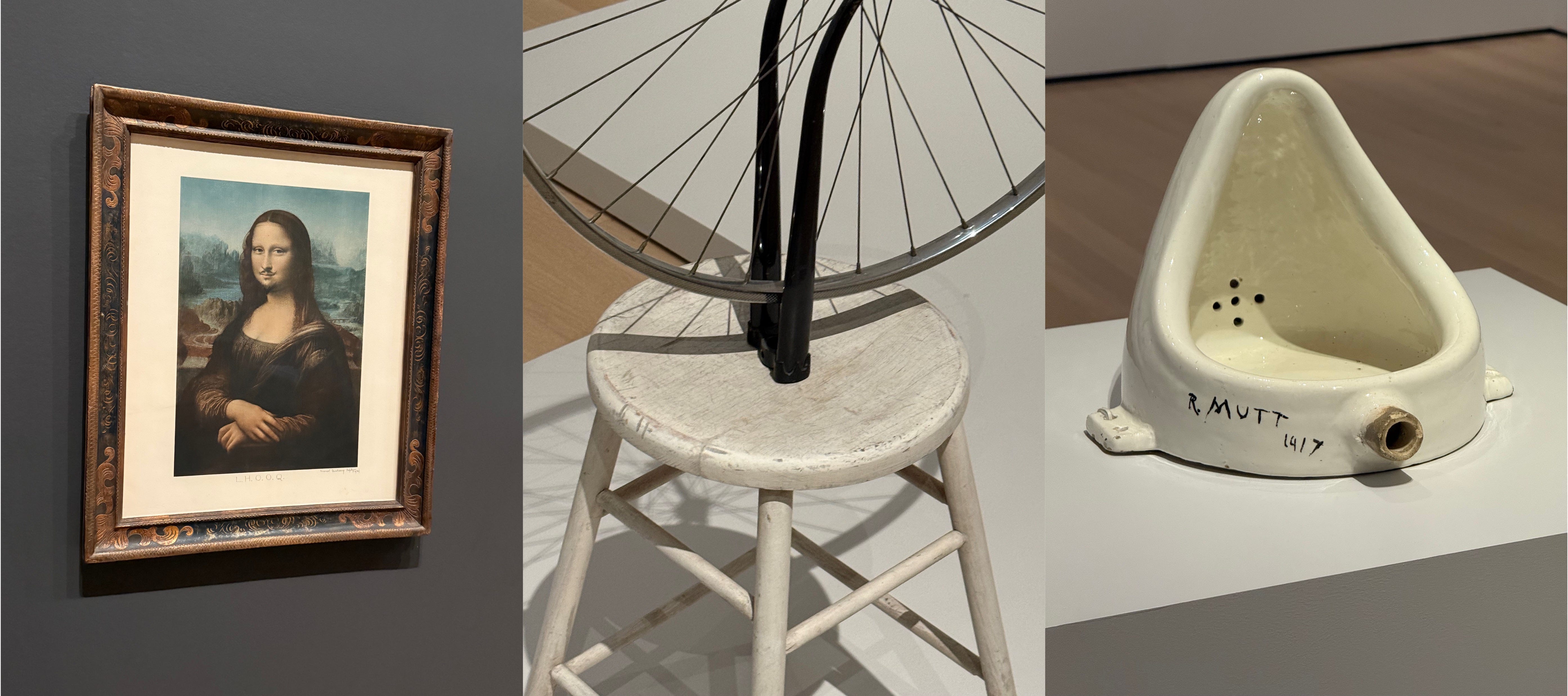
The middle section of the show was presented in a black box format—a film projection, mini readymade replicas, precise notes, his “museum in a box” concept, and the surprisingly small-scale defaced Mona Lisa.
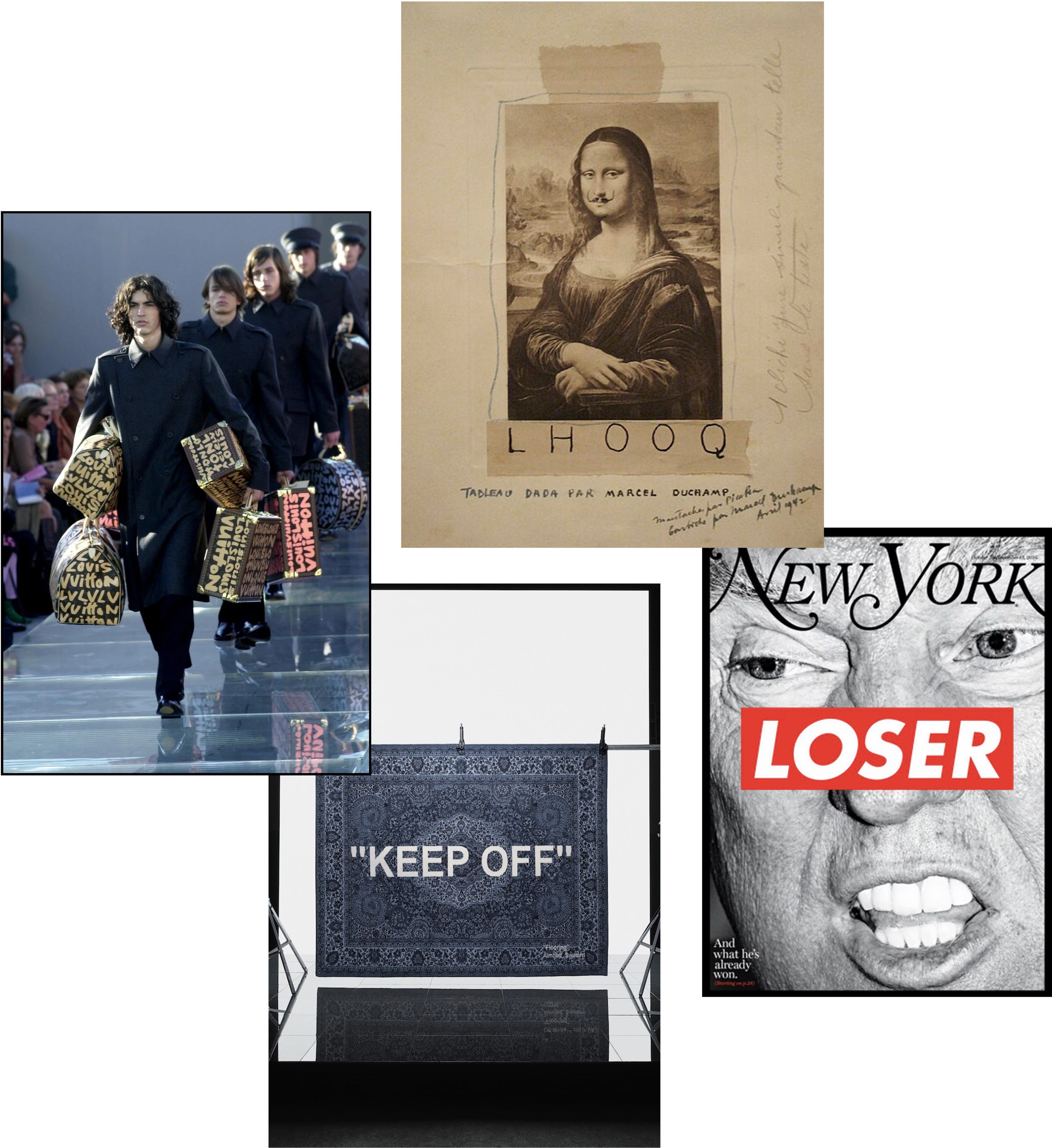
L.H.O.O.Q. is the kind of work that has given generations of artists permission to reduce, reuse, and recycle meaning—to take something already embedded in our collective consciousness and wring it out into something new. The cheeky mustache Duchamp drew on a postcard of the Mona Lisa in 1919 feels spiritually connected to Stephen Sprouse, Richard Prince, and Takashi Murakami on Louis Vuitton handbags under Marc Jacobs. It’s Barbara Kruger declaring Trump a “loser” on the cover of New York Magazine. It’s Virgil Abloh designing an IKEA rug that simply reads “KEEP OFF.”
It would be easy to lose sight of how revolutionary this concept was because in contemporary terms, everything and anything is considered art regardless of its beauty, its rigor, or its intended meaning. What once felt like a provocation now reads more like a base proposition.
While it made sense practically to keep this room low-lit—with dark walls and soft lighting to accommodate projections and to subtly disorient the viewer—I couldn’t help but feel it worked against some of Duchamp’s humor or anti-art position. It felt like a serious looking room full of Serious Art, which seems like the opposite of what he proposed throughout his career.
Defacing arguably the most famous portrait of a woman removes expectations of how art should be respected over time, and it also connects to Duchamp’s ongoing fixation with interpreting women. Many of his early works center the female form, and at one point he adopted a female persona, Rrose Sélavy, posing seductively in photographs as part of his Dadaist practice.
It’s hard to tell whether this was pure provocation, humor at women’s expense, or something more complex. Perhaps it’s a self-aware attempt to destabilize gender in an artistic space overwhelmingly dominated by men.
L.H.O.O.Q. may be one of his most recognizable works (a tourist was quickly admonished for standing too close for a selfie confirmed as much), but it wasn’t until the next gallery that Fountain appeared. Originally a porcelain urinal turned on its side and signed with his pseudonym “R. Mutt,” it confronts every expectation of what an art object can be.
Its appeal lies in universal recognition, but I couldn’t help noticing how many of these readymades feel not so subtly coded as male—objects easily within reach of men: a bottle rack, a wheel, a urinal. I couldn’t tell if this was meant to expose the absurdity of gender, but the question felt more important than the answer.
All of the objects were literally replicas, either because the originals were discarded by Duchamp or they were lost over time. Can an object retain meaning if it’s been reproduced endlessly from its original source? Does it matter?
I had a similar thought last summer at the Brandt Foundation in the East Village, standing in a gift shop filled with mini reproductions of Jeff Koons, Andy Warhol, and Keith Haring. Does someone buying a small plastic Koons balloon dog recognize its cultural weight—or care that the original sells for millions?
The final room featured a work Duchamp created in secrecy over the last two decades of his life. Étant donnés: 1. La chute d’eau, 2. Le gaz d’éclairage is constructed from an old wooden door with two peepholes. Looking through them reveals a surreal diorama of a nude woman, legs splayed, holding a gas lamp.
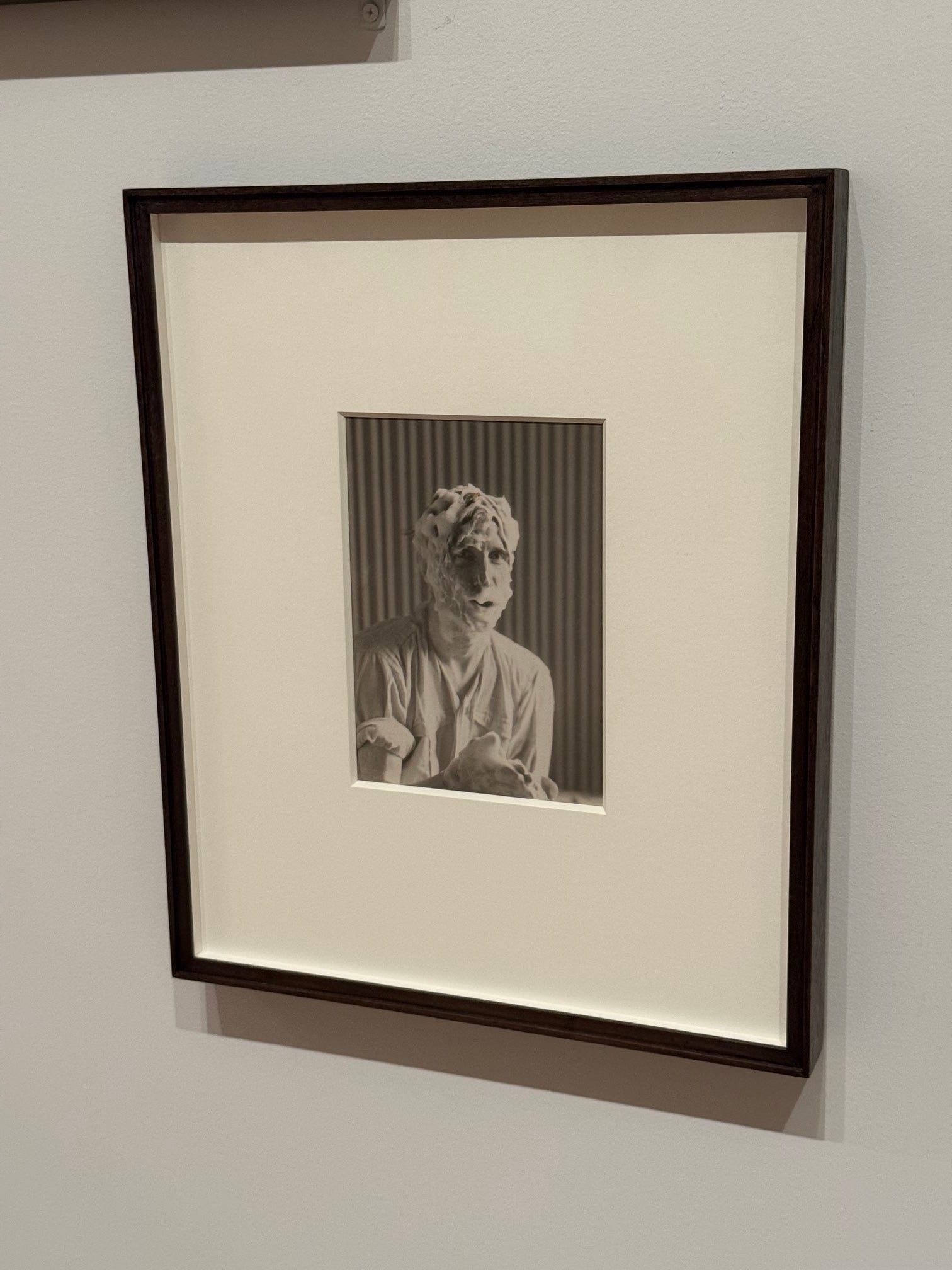
The original lives at the Philadelphia Museum of Art and is too fragile to travel, so a series of Polaroids documenting its construction are shown instead. Doors, glass panes, peepholes, spinning discs—Duchamp repeatedly disorients the act of looking, making the viewer complicit. You’re often not just passively observing Duchamp’s work so much as you are an unknowing participant in it—looking through what could essentially be a glory hole.
I wanted to ask Steiro what she thought of the exhibit, but in one quick move she was gone. She seemed amused, quietly drawn in by the objects on display. She paused at works like Female Fig Leaf, a sculptural impression of a woman’s genitalia.
Voyeurism and the act of looking, or re-looking, felt like the thread connecting everything in the show. Fitting, then, that I spent the afternoon observing Duchamp while also observing someone else doing the same.
A little further uptown, the Gagosian gallery—formerly a few floors up at 980 Madison Avenue—has moved to a ground-level space on the corner of 76th Street. For its first show, a selection of Duchamp readymades were on view, along with a selection of early works by Robert Rauschenberg.
I was fond of the previous gallery (I saw the Jasper Johns show before it closed—the last in that space). The skylight in the main room was just right for many of the shows I saw there, as was the bowl of mints at the security desk on the way out.
The new space felt more spatially intimate than the Gagosian galleries in Chelsea, Beverly Hills, and London (all great locations). I wish they made more use of the ground-floor windows as the galleries feel too closed off from the street.
Naturally, there was overlap in objects with the MoMA show, with his most recognizable works on display here—L.H.O.O.Q., Bicycle Wheel, Hat Rack, Fountain, and Fresh Widow, all reproductions from 1964.
The small room of Rauschenberg works included a phallic, unnamed sculpture of glass bottles and a long tube, along with other constructions of crates, glass, rope, stone, and wood. They’re simple, recognizable found objects—similar to Duchamp in that they carry rough, almost masculine connotations, and they pose the same question: can anything be considered art?
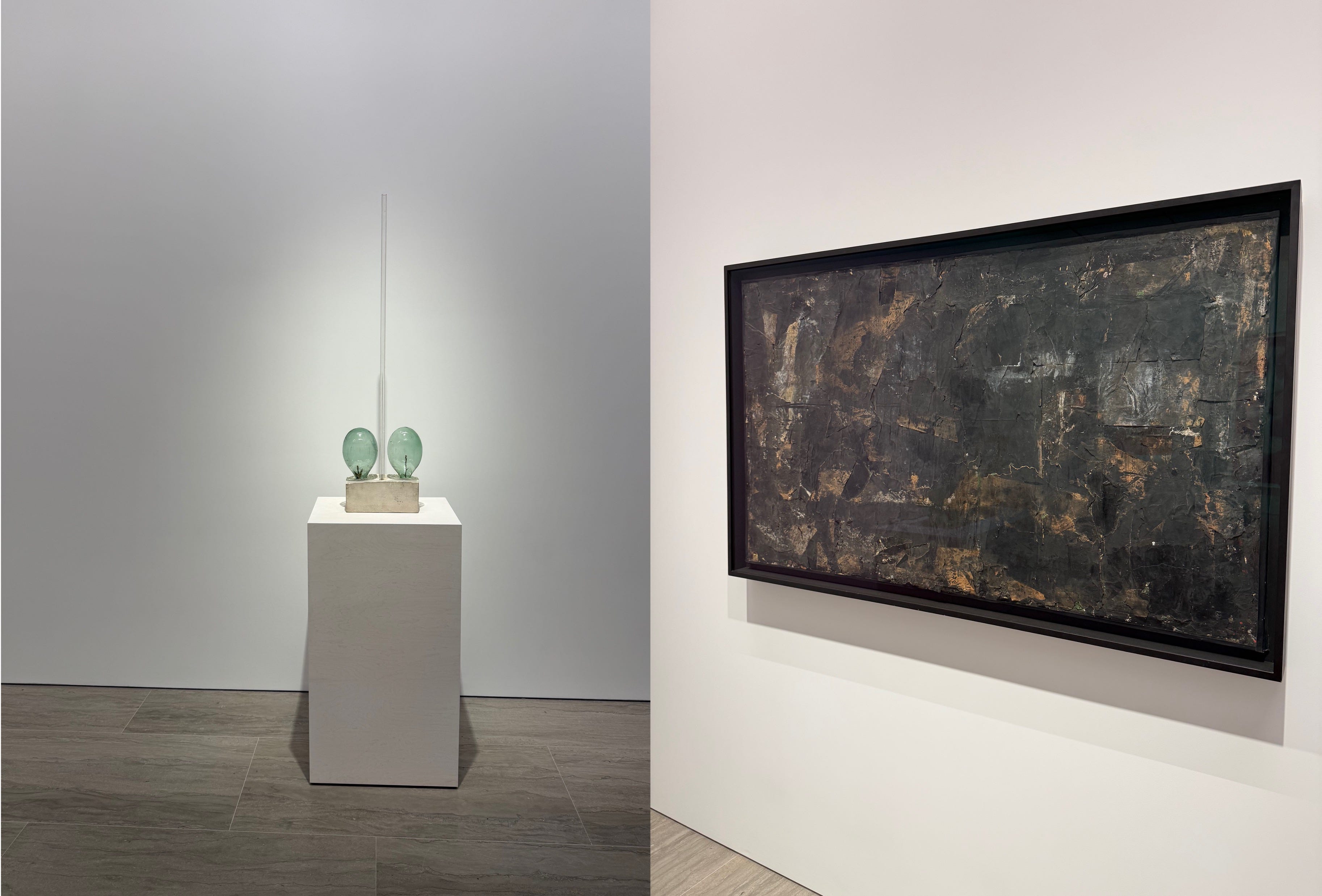
It might seem obvious to put Duchamp’s influence in context by placing other artists in direct spatial relation to his. I almost wondered if it would have been more impactful for that to occupy the expansive 6th floor at MoMA, while the smaller Gagosian show could have focused on Duchamp’s early drawings and paintings—no urinals or stools in sight.
On my way out of completing my double bill of Duchamp, I couldn’t think of the last time I saw one artist represented at two major shows in the same city at the same time. Why him?
Some of his work is a century old, yet it created the template for much of what we consider culturally innovative today. Imagine a Duchamp and Louis Vuitton collaboration or if he made a series of filmed portraits on an iPhone—it would make perfect sense.
Duchamp’s work spans life before and after World War I, touching on the constraints of capitalism, gender norms, and a looming sense of conservatism. It’s not unlike today’s upside-down reality, where the surreal is easy to confuse with what’s real—and where the logic of the readymade has become part of our daily habit: selecting, reframing, and redistributing meaning in real time.
Looking through a peephole, as Duchamp instructed viewers to do, is exactly how he would want us to look at the world now.
A subscription gets you:
✓ Subscriber-only essays
✓ Early access to new series and interviews
✓ Select archive access to earlier pieces
If you’ve been reading for a while, subscribing is the most direct way to support the work—and stay close to it.
Cannot wait to see these. Going to MoMA next week!